5 signs a text is a scam
Scammers are increasingly sending out fake text messages posing as banks. To protect yourself, it’s crucial to recognize these five signs of a scam.

Scammers are increasingly sending out fake text messages posing as banks. To protect yourself, it’s crucial to recognize these five signs of a scam.
When you receive an unknown text, it’s time to put on your detective hat. A bank text scam can often look like a real text message from your bank. These imposters may text you about a bank warning or fraud alert. In other cases, the text might be about an unauthorized charge on your account.
While some of these texts may be easy to spot, others can look very convincing. These messages are designed to trick you into sending confidential information or money. Stop and think before you respond or click on a link. Remember The Bank of Missouri will never text, email or call you asking for your personal or account info. Nor will we ask you to send money to avoid a fraud event. If you’re ever in doubt, reach out to our team directly to make sure the message is valid.
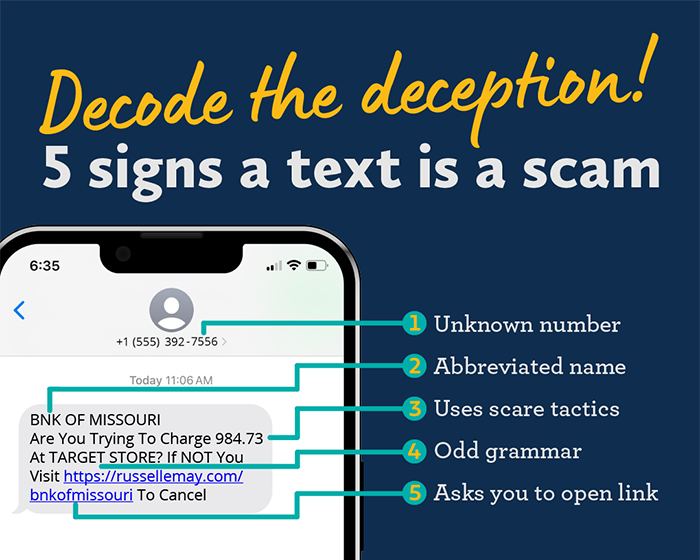
Decode the deception!
5 signs a text is a scam
1. Unknown number
2. Abbreviated name
3. Uses scare tactics
4. Odd grammar
5. Asks you to open link
In most cases, texts from an unknown number should raise a red flag. Especially if you receive the text out of the blue and don’t have prior text history with that number. Before taking any action, check to see if that’s the number your bank usually uses to send text messages.
Even when you get a text from a recognized number, don’t automatically assume it’s safe. Still review the content to be sure, be suspicious of links and if in doubt, always ask.
Take these steps to be safer with unknown numbers:
Sometimes scammers abbreviate company names or even get them outright wrong. It’s one more thing to watch for as you try to keep your money and info safe.
When someone asks you to take an urgent action and something bad will happen if you don’t act right away, that’s another red flag.
You do not ever have to act quickly. Always take a minute to stop and evaluate the text. You owe it to yourself, and no one deserves your immediate response. Do the work to confirm if the text is valid first.
Scammers create a false sense of urgency to trip you up. And, they can be convincing. “Act now to secure your bank account” can sound pretty scary. Don’t fall for it!
It’s common to see grammar that is a little off in scam texts. Going back to the example at the top, it asks if you made a purchase at “Target store.” Odd, right? You don’t have to be an English teacher here. You’ll often spot missing or incorrect words and spelling mistakes pretty quickly. Perfect grammar doesn’t mean a message is safe, but poor grammar is definitely a clue to a scam.
We cannot overstate enough the risks of visiting links from texts. A scammer’s main goal is to get access to your money or sensitive information. Links are a key tool they use. They hope to capture your log in or other info in a couple of ways here.
Banks rarely, if ever, send links via text. So your best bet is don’t click them. Always go directly to your bank’s website or use their official mobile banking app to log in.
Keep in mind, criminals may simply try to get this info from you in a text reply, no link needed. They may say they just need your log in info in order to take care of an issue with your bank account. Or you can make money if you give them your credit card number or send them money orders or gift cards. They may even pretend to be a family member in need. The reality is, scammers are convincing. And, will go to extreme lengths to get you to fall for their tricks.
We’re committed to helping you spot scams. Because when you know something sounds suspicious, you can stop criminals in their tracks. If you receive a text claiming to be The Bank of Missouri, it’s always best to stop and think. Don’t click a link, give them your info, or even respond. And if you feel unsure about a text, call us at 888-547-6541 to verify or report any concerns.
You are leaving The Bank of Missouri website.
External third-party websites will be presented in a new and separate content window. The Bank of Missouri does not provide, and is not responsible for, the product, service, overall website content, availability, accessibility, security, or privacy policies on any external third-party sites. We encourage you to review their privacy and security policies which may differ from The Bank of Missouri. The inclusion of any hyperlink does not imply any endorsement, investigation, verification or monitoring by The Bank of Missouri of any information in any hyperlinked site.
Email is not a secure method of communication and should NOT be used to send personal or financial information.